Not every device deserves shelf space. These five categories — sleep trackers, sound machines, blue light blockers, red light therapy panels, and weighted blankets — are the ones with genuine evidence behind them. We ranked what's actually worth buying.
Skip straight to the right pick for your situation — detailed breakdowns follow below.
| Device | Category | Best For | Price Range | Badge |
|---|---|---|---|---|
| Withings Sleep Tracking Pad | Sleep Tracker | Deep sleep data without wearing anything | $$ | Best Tracker |
| LectroFan EVO Sound Machine | White Noise | Noise masking for light/irregular sleepers | $ | Best Sound |
| Sleep ZM Blue Light Glasses | Blue Light Blocking | Pre-sleep screen use and melatonin timing | $ | Best Blocker |
| Hooga HG300 Red Light Panel | Red Light Therapy | Evening recovery & circadian entrainment | $$ | Best Red Light |
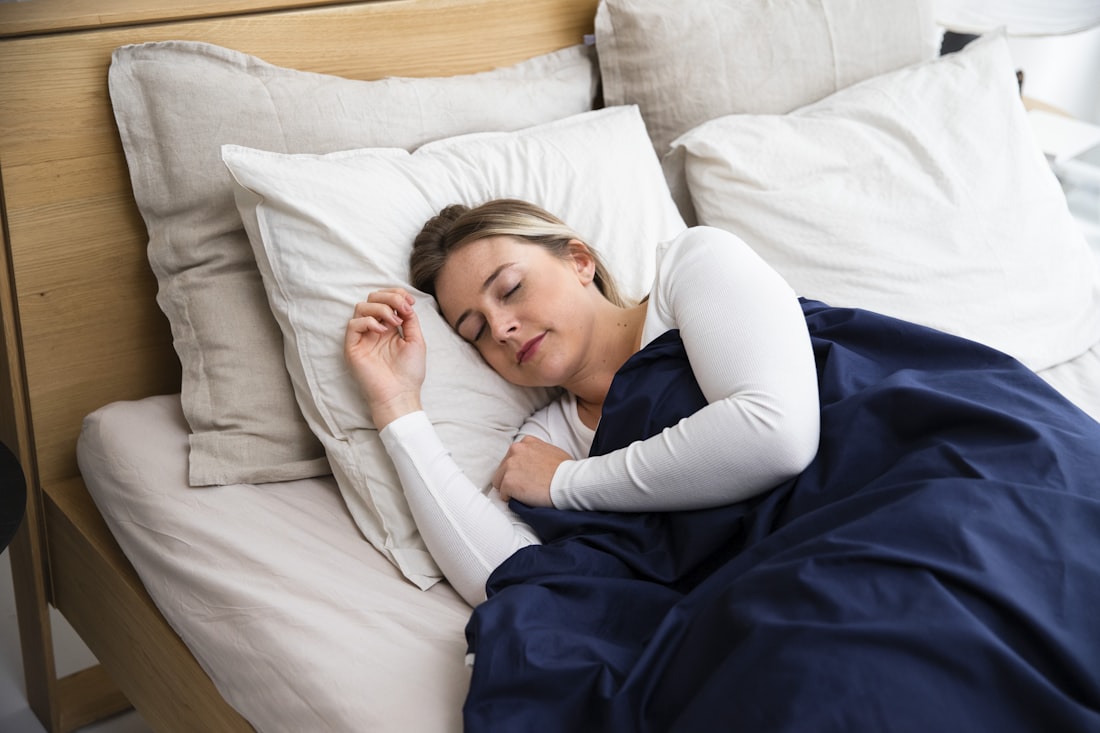
| YnM Weighted Blanket | Weighted Blanket | Anxiety-related sleep disruption, general calm | $ | Best Blanket |
We evaluated each device against four criteria. No sponsored placements. No guesswork.
Does the underlying mechanism have peer-reviewed support? We don't rank gadgets built on marketing claims.
Does this device produce measurable differences in how people fall asleep, stay asleep, or feel upon waking?
Will you actually use it nightly? The best sleep device is one that integrates seamlessly into your routine.
The price must be proportional to the impact. Premium devices earn their cost. Budget picks must deliver results.
Most sleep trackers require you to wear something — a wristband, a ring, a watch — which introduces its own disruption. The Withings Sleep Pad solves this elegantly by placing itself under your mattress, invisible and forgotten, tracking every movement through the night via a pneumatic sensor.
What it captures is genuinely useful: deep, light, and REM sleep cycles; heart rate throughout the night; snore detection; and breathing disturbance patterns that may suggest early-stage sleep apnea risk. The automatic sync to the Health Mate app delivers a Sleep Score each morning along with color-coded indicators for six key sleep factors. You can download your sleep diary as a PDF and share it with a physician — a real differentiator in a consumer product.
Affiliate link — no additional cost to you.
The mechanism behind sound machines is well established: consistent ambient noise masks the transient sounds — a car passing, a neighbor's voice, a partner shifting — that pull light sleepers into full wakefulness. The LectroFan EVO executes this better than almost any product at its price point.
Twenty-two non-looping sounds (ten fan sounds, ten white noise variants, two ocean sounds) are generated algorithmically, meaning they never have a detectable repeat. The precision volume control spans a wide range. It's USB-powered, compact enough for travel, and the addition of ocean sounds in the EVO variant over the Classic makes it the version to choose.
Affiliate link — no additional cost to you.
Related Reading
The research on blue light and melatonin suppression is consistent: wavelengths between 400–490nm significantly inhibit the pineal gland's melatonin output when encountered in the hours before sleep. Screens — phones, televisions, computers — are a dense source of this wavelength at exactly the time most people are using them.
Sleep ZM's nighttime amber-lens glasses block 99% of the blue spectrum while remaining comfortable enough to wear for a full evening of use. The wayfarer-style frame fits most face shapes well, and the amber tint is strong enough to be genuinely effective rather than the token "slight tint" that appears in cheaper products. For under $30, this is one of the highest return-on-investment interventions for sleep that exists.
Affiliate link — no additional cost to you.
Red and near-infrared light (660nm and 850nm) do not suppress melatonin the way blue-spectrum light does, making an evening session possible without disrupting circadian timing. The research suggests that 660nm light supports cellular mitochondrial function and may influence circadian clock genes, while 850nm penetrates deeper into tissue to support muscle recovery and nervous system calm.
The Hooga HG300 is a practical entry point for home red light use: 60 high-output LEDs in a 1:1 red-to-near-infrared ratio, a built-in timer, and an adjustable stand that allows floor, wall, or tabletop positioning. It's not a clinical-grade device, but for daily 10–15 minute evening sessions aimed at improving sleep quality and recovery, it delivers real value at a sensible price.
Affiliate link — no additional cost to you.
Deep pressure stimulation — the mechanism behind weighted blankets — has been studied in the context of anxiety, sensory processing, and sleep onset. The sustained, distributed weight activates proprioceptive feedback in a way that can lower physiological arousal, support parasympathetic tone, and reduce the restlessness associated with anxious wakefulness.
YnM's original weighted blanket remains one of the most trusted options because of its precise glass bead distribution (2"×2" compartments using the finest industry stitching), the 7-layer construction, and the breadth of verified real-world feedback it has accumulated. The 17lb/60"×80" configuration is appropriate for a single adult in the 130–190lb range. Machine washable.
Affiliate link — no additional cost to you.
Start with the Withings Sleep Pad. You need data before you need devices.
The LectroFan EVO is your first priority. Reliable noise masking is foundational.
Sleep ZM glasses before anything else. They're the cheapest fix with the highest ROI.
The YnM weighted blanket specifically addresses physiological arousal at bedtime.
The Hooga HG300 evening sessions support tissue recovery alongside sleep quality.
Sleep trackers don't directly improve sleep, but the behavioral data they generate is powerful. Seeing how alcohol consumed at 8pm affects your REM percentage, or observing how your deep sleep improves with consistent bedtimes, gives you concrete feedback to act on. The Withings Sleep Pad is particularly effective here because it captures breathing disturbances that many wearables miss.
An evening session of 10–15 minutes, ideally 60–90 minutes before bed, appears to be optimal. The goal is to support cellular energy production and circadian signaling without being bright enough to delay melatonin onset. Avoid the panel within 30 minutes of bed if you're sensitive to any light stimulus.
Always use eye protection during panel sessions — the provided goggles or appropriate protective glasses. The 660nm and 850nm wavelengths themselves aren't harmful in typical usage, but the intensity of a panel at close range warrants protection. Don't look directly at the LEDs.
Most people notice reduced sleep onset time within the first few nights, particularly if their sleep disruption is anxiety-related. Deeper, sustained benefits to sleep architecture take longer to assess — allow 2–4 weeks before evaluating whether it's working for you.
Absolutely, and many serious sleep optimizers do. A suggested layered approach: wear blue light glasses from 9pm onward → 15-min red light session → white noise machine running through the night → weighted blanket → sleep pad collecting data. The combination addresses multiple disruption pathways simultaneously.
Start with the tracker to understand your baseline, then add devices that target your specific disruption patterns. No guessing — data first, devices second.